
Sugar-Free Peach Galette — a Rustic Summer Tart With No Added Sugar at All
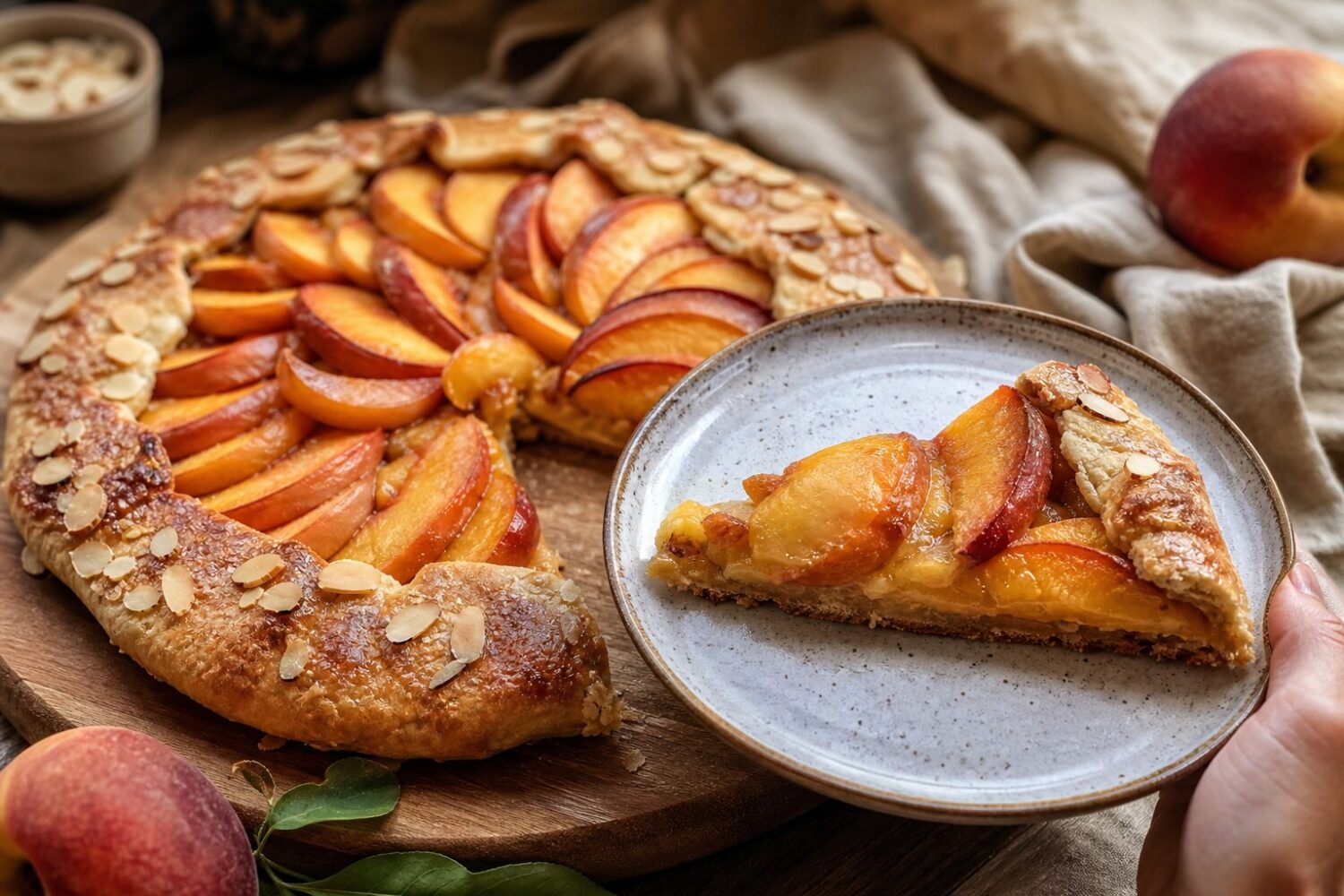
A galette is what you make when a pie feels like too much commitment. No tin, no lattice, no blind baking: the pastry gets rolled into a rough circle, the fruit piles into the middle, and the edges fold over in whatever pleats happen. It is the most forgiving pastry in the sugar-free baking repertoire, which is exactly why it is the right place to let ripe peaches do all the sweetening.
This sugar-free peach galette gets its entire 11 grams of sugar per slice from the fruit itself. Nothing granulated goes into the filling, nothing goes into the crust, and the only thing sweetening the top is a brush of egg wash that browns rather than candies.
The trade-off is honest: this is less sweet than a bakery peach tart, and it tastes considerably more like peaches. Whether that is a downgrade depends entirely on the peaches.
Why the Peaches Have to Carry This One
A peach at the right stage of ripeness runs around 13 grams of natural sugar in a medium fruit, and yields to gentle thumb pressure at the shoulder near the stem. That fruit needs no help. A peach that is still firm at the shoulder has starch where the sugar should be, and no amount of maple syrup convinces it otherwise. It bakes into something tart and slightly mealy.
Freestone varieties are worth seeking out in late summer specifically because the flesh releases from the pit cleanly, which matters when slicing thin. Clingstone peaches fight the knife and shred into the filling.
If the only peaches available are underripe, the fix is time rather than sugar: a paper bag on the counter for two days, checked daily. The ethylene the fruit gives off speeds itself up in a closed bag. Refrigerating an underripe peach stops the process permanently, which is how most disappointing peaches happen.
A Crust Built Without Sugar or Butter
Conventional pastry uses sugar for tenderness and browning as much as sweetness, so pulling it out means rebalancing what is left. The dough here runs on oat flour and almond flour in a 2:1 ratio, with coconut oil as the fat, solid and cold, worked in until the mixture looks like coarse gravel with some pea-sized lumps still visible.
Those lumps matter more than tidiness. Each one turns to steam in the oven and leaves a flake behind. A dough worked smooth bakes into a cracker.
Almond flour brings the fat and the faint sweetness that sugar used to supply. It also makes the dough noticeably more fragile than a wheat crust, which sounds like a problem and is actually the reason a galette suits it: a free-form tart has no sides to hold and no tin to unmould from. A crack at the edge is a rustic feature rather than a structural failure.
Ice water goes in a tablespoon at a time until the dough just coheres when squeezed. Then it rests in the fridge for a full thirty minutes. Skipping the rest is the single most common way this crust turns out tough, because the coconut oil needs to be properly firm again before it meets a rolling pin.
The Layer That Stops a Soggy Bottom
Peaches release a startling amount of liquid. Without something between the fruit and the pastry, the base of the galette poaches instead of baking, and the first slice comes out with a pale, wet underside.
Three tablespoons of almond flour mixed with a tablespoon of oat flour, scattered across the dough in a thin layer before the fruit goes on, solves it entirely. The mixture drinks the juice as it renders and turns into something closer to a frangipane, which is a considerably better outcome than a dry barrier.
The filling itself gets a teaspoon of ground chia rather than cornstarch. Chia thickens without needing to reach a boil, which suits a tart that never gets stirred, and it holds its set as the galette cools rather than weeping back to liquid the way an under-cooked starch will.
A squeeze of lemon and a half teaspoon of cinnamon finish the fruit. Lemon does something specific here beyond flavour: acid keeps the cut peach from browning during the ten minutes it takes to shape the pastry.
Shaping It Without Fussing
Roll the chilled dough between two sheets of parchment to about eleven inches across and a scant quarter inch thick. Rolling between parchment is not a nicety with a flourless dough, it is the only reliable way to move it without tearing, and the bottom sheet goes straight onto the baking tray with the galette still on it.
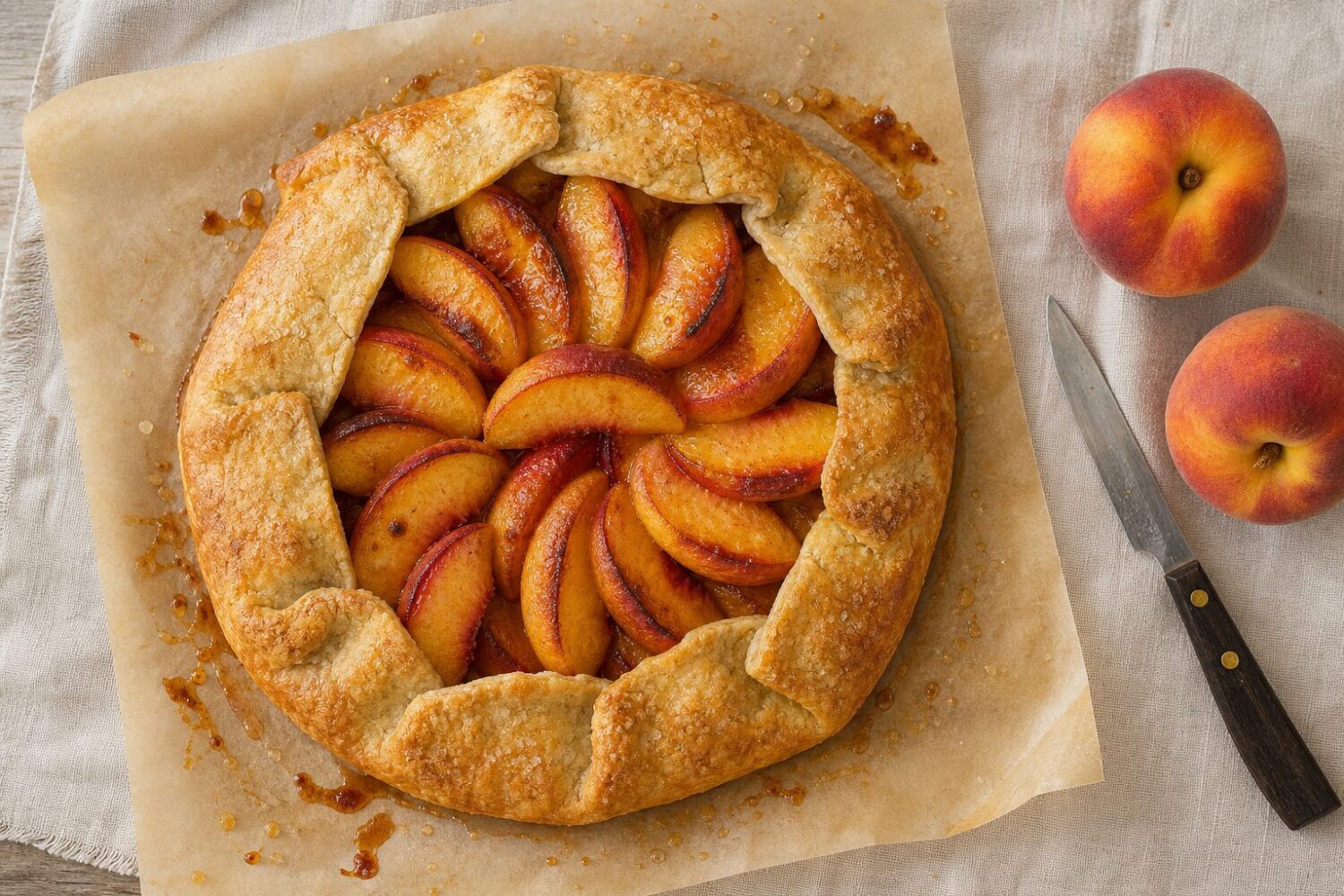
Leave a two-inch border clear. Pile the peaches in overlapping arcs rather than a heap, which helps them cook evenly and looks deliberate for no extra effort. Then fold the border up over the fruit in five or six sections, pressing each pleat lightly where it overlaps the last.
The centre stays open. That exposed fruit is where the liquid evaporates, and covering it turns the filling soupy.
Brush the pastry with beaten egg. This is the step that produces the deep golden edge people associate with sugar, using the Maillard reaction on the egg proteins instead. A sprinkle of flaked almonds on the border adds crunch and browns at the same rate as the crust.
Baking and the Cooling Nobody Waits For
Forty minutes at 400°F on the middle shelf, until the pastry edge is properly brown and the fruit at the centre is bubbling rather than merely hot. Pale pastry is under-baked pastry here; a flourless crust needs colour to finish crisping.
Then it has to cool completely, and this is where most galettes are ruined. Cut warm, the chia-thickened juice runs across the plate and the base goes soft within minutes. Left alone for at least an hour, the filling sets into something sliceable and the residual heat finishes drying the underside of the crust.
Ninety minutes is better than sixty. An hour is the minimum that produces a clean slice.
Swaps That Hold Up
Nectarines work identically and skip the peeling question entirely, since their skin is thin enough to leave on. Plums work but run more acidic, so they want the cinnamon swapped for a scrape of vanilla. Apricots collapse; they are better in a crumble.
For a nut-free version, sunflower seed flour replaces the almond flour in both the dough and the barrier layer at a one-to-one ratio. The crust browns slightly faster, so check at thirty-five minutes.
Coconut oil can be swapped for cold butter in the same quantity if dairy is not a concern, and the dough becomes noticeably easier to handle. The galette keeps its no-added-sugar status either way, since the sugar was never in the fat.
What does not work: frozen peaches. They carry too much water and turn the filling into a sauce no amount of chia rescues. If frozen fruit is the only option, a baked recipe with a closed structure handles it far better than an open tart.
Frequently Asked Questions
Does a sugar-free peach galette really need no sweetener at all?
With properly ripe peaches, no. The fruit brings roughly 11 grams of sugar per slice on its own, and the almond flour layer under the fruit reads as sweet once it has absorbed the juice. If the peaches are on the tart side after slicing, taste one first and add a tablespoon of maple syrup to the filling rather than adjusting anything else. That still lands well under a conventional peach tart, which typically carries three times the sugar per slice.
Do the peaches need to be peeled?
Not for a galette. Peach skin softens completely during a forty-minute bake and helps the slices hold their shape rather than collapsing into the filling. Peeling is worth doing only if the fruit is fuzzy enough to be unpleasant, in which case thirty seconds in boiling water and a plunge into ice water slips the skins off without cooking the flesh.
Why did my galette leak juice all over the tray?
Almost always a pleat that did not seal. Where the folded border overlaps itself, press the two layers together firmly rather than just laying one over the other, because the gap opens further as the pastry shrinks in the heat. A leak is also more likely if the fruit was piled high in the centre instead of arranged in flatter overlapping arcs. Some caramelised drips on the parchment are normal and taste better than they look.
Can the dough be made ahead?
Yes, and it improves. Wrapped tightly, the disc keeps for two days in the fridge and three months in the freezer. Let a frozen disc thaw overnight in the fridge rather than on the counter, since a flourless dough goes from too firm to too soft with very little warning. Roll it out cold.
Is this gluten-free?
The recipe as written contains no wheat, but oat flour is only gluten-free if the oats are certified as such. Standard oats are routinely processed on equipment shared with wheat. If that matters in your kitchen, use certified gluten-free oat flour and check the almond flour bag for the same shared-line warning.
The slice nobody claims is the one where a pleat gave way and the peaches ran, which is also reliably the sweetest part of the tart.
Recipe Card
Nutrition values are good-faith estimates and vary with the exact brands and quantities you use.
Ingredients
- 1 cup oat flour (certified gluten-free if needed)
- 1/2 cup almond flour
- 1/3 cup coconut oil, solid and cold
- 3 to 4 tbsp ice water
- 1/4 tsp salt
- 4 medium ripe freestone peaches, sliced 1/4 inch thick
- 1 tsp ground chia seed
- 1 tbsp lemon juice
- 1/2 tsp ground cinnamon
- 3 tbsp almond flour plus 1 tbsp oat flour, for the base layer
- 1 egg, beaten, for the wash
- 2 tbsp flaked almonds (optional)
Instructions
- Whisk the oat flour, almond flour and salt together. Work in the cold coconut oil until the mixture looks like coarse gravel with some pea-sized lumps still visible.
- Add ice water a tablespoon at a time until the dough just coheres when squeezed. Shape into a disc, wrap, and chill for 30 minutes.
- Heat the oven to 400F. Toss the peach slices with the chia, lemon juice and cinnamon.
- Roll the chilled dough between two sheets of parchment to an 11-inch round, a scant 1/4 inch thick. Slide the bottom parchment onto a baking tray.
- Mix the 3 tbsp almond flour with 1 tbsp oat flour and scatter it over the dough, leaving a 2-inch border clear.
- Arrange the peaches over the floured area in overlapping arcs. Fold the border up over the fruit in five or six pleats, pressing each pleat firmly where it overlaps the last.
- Brush the pastry with beaten egg and scatter over the flaked almonds.
- Bake 40 minutes, until the crust is deeply golden and the fruit at the centre is bubbling.
- Cool completely, at least an hour, before slicing. Cutting it warm will let the filling run.